

Geochemical baselines

One target of the geochemical baseline mapping programme is to establish the value for upper limit of baseline variation (ULBL, in Finnish SSTP). The ULBL value is the highest concentration of a studied element in a research area (geochemical province or area around a study site) that is not considered anomalous.
The definition of the ULBL value is based on a box-and-whisker plot, as suggested in the SFS-ISO-standard 19258.
At least 30 samples are needed for the calculation. The upper limit of geochemical baseline variation for element X (ULBLX) can be calculated as follows:
ULBLX = P75 + 1,5 x (P75 – P25) [Equation 1]
where
P75 = 75th percentile of element X concentrations
P25 = 25th percentile of element X concentrations.
However, if the highest observed value is lower than the calculated ULBL value, the maximum value of the dataset is used as the ULBL. Equation [1] is used to estimate a parameter that takes into account high natural concentrations but eliminates single anomaly points.
The ULBL value should be used as a trigger value for the assessment of soil contamination if the ULBL value is higher than the threshold value given in the Government Decree on the Assessment of Soil Contamination and Remediation Needs (214/2007). Many of the guideline values have been defined on the basis of ecological risk, and the national baseline levels are considered in the derivation process. If regional geochemical baseline values are available, the guideline values based on ecological risks can be modified accordingly (Reinikainen 2007). Regional guideline values can also be taken into account in the definition of target concentrations for soil remediation.
Guideline values can be used for defining restrictions on future land use or in the application of excavated soil materials.
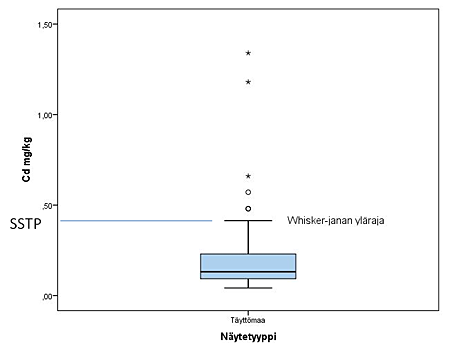
Fig. 1. Box-and-whisker plot.
